Insights
Back to InsightsHow to Read a Fabric Spec Sheet: Yarn Count & Construction Explained
March 2026 · 6 min read
FABRIC SPECIFICATION
100% COTTON
CPT70 × CPT70
200 × 100
LIQUID AMMONIA
WIDTH: 57/58″
If you're not sure what half of that means, you're not alone. Most buyers — even experienced ones — don't fully understand every number on a fabric spec sheet. They know enough to place an order, but not enough to compare two fabrics with confidence or spot a bad spec before it turns into a bad shipment.
This guide breaks it all down in plain language — no textile engineering degree required. By the end, you'll be able to pick up any shirting fabric spec sheet and know exactly what you're looking at.
The Two Numbers That Define a Fabric
Every woven shirting fabric is defined by two core specs:
- Yarn count — how fine or coarse the yarn is
- Construction — how tightly those yarns are packed into the fabric
Everything else — the weight, the feel, the drape, the price — flows from these two numbers. Get them right, and you're sourcing with precision. Ignore them, and you're guessing.
Yarn Count: The Fineness of the Thread
Yarn count tells you how thick or thin the yarn is — the individual thread, before it's woven into fabric.
In shirting, it's almost always written as a number followed by "s" — like 40s, 60s, 80s, or 100s. You might also see it written as Ne (which stands for English cotton count), but it means the same thing.
How it works
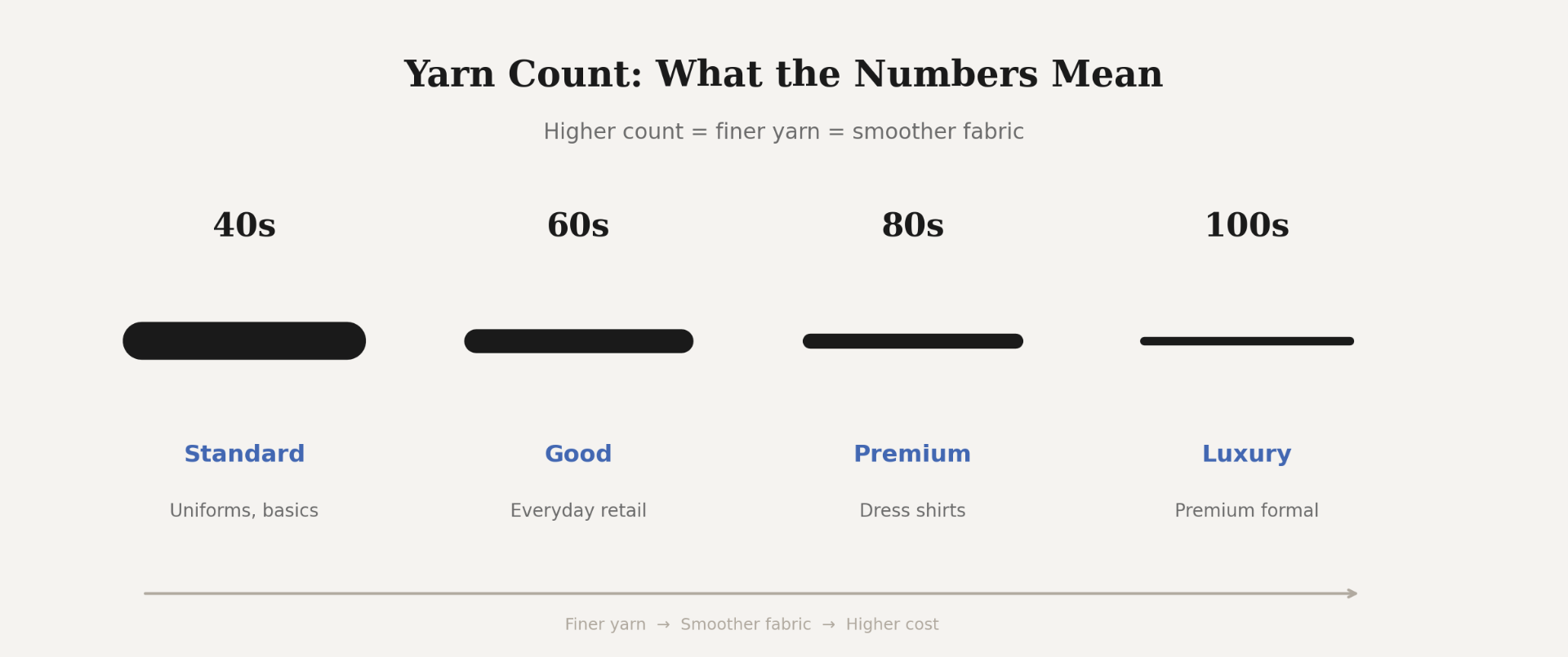
Here's the simple way to think about it: the number tells you how fine the yarn is.
- 40s = relatively thick yarn
- 80s = much finer yarn
- 100s = very fine yarn
The higher the number, the finer the yarn.
Imagine stretching out one pound of cotton into yarn. With thick yarn (40s), you get fewer, shorter lengths. With fine yarn (100s), you can stretch that same pound into many more lengths — because each thread is thinner.
Why does this matter? Finer yarns produce smoother, lighter, more luxurious-feeling fabric. But they're also more delicate and more expensive to produce. So the yarn count is essentially telling you where a fabric sits on the scale from "basic" to "luxury".
What the prefixes mean
On a spec sheet, you'll often see letters before the count number. These tell you how the yarn was spun:
| Prefix | Meaning | What it tells you |
|---|---|---|
| C | Combed | Short fibres removed, smoother and stronger than carded |
| CPT or CMP | Compact | Advanced spinning — even smoother, less hairy, more durable |
| CD | Carded | Basic processing, slightly rougher, more affordable |
| R/S | Ring spun | Standard quality spinning method |
| OE | Open end | Cheapest method, coarser yarn |
So when a spec sheet says CPT70, it means: compact-spun, 70s count yarn. In plain terms — this is a high-quality yarn that's fine, smooth, and produces a clean-looking fabric.
If you see just a number with no prefix (like 70s), it usually means combed ring-spun — which is standard good quality. The prefix is there to tell you something extra about how it was made.
The yarn count range for shirting
| Count | Grade | Typical use |
|---|---|---|
| 20s–30s | ●Coarse | Denim, heavy workwear, canvas |
| 40s | ●Standard | Uniforms, basic casual shirts, value range |
| 50s–60s | ●Good | Everyday retail shirts, reliable quality |
| 80s | ●Premium | High-quality dress shirts, refined hand feel |
| 100s | ●Luxury | Premium formal shirts, very smooth and soft |
| 120s–200s | ●Ultra-luxury | Bespoke and designer shirts — beautiful but fragile |
For most shirt brands, the sweet spot is 60s to 80s. That's where you get genuinely good quality without sacrificing durability. Go below 50s and the fabric starts to feel rough. Go above 100s and it becomes delicate — great for luxury, impractical for everyday wear.
What about warp × weft?
When a spec sheet shows yarn count as CPT70×CPT70, the two numbers represent:
- First number = warp yarn (the vertical threads that run up and down the fabric)
- Second number = weft yarn (the horizontal threads that run side to side)
If both numbers are the same (like 70×70), it means the same yarn is used in both directions. If they're different (like 80×60), the vertical threads are finer than the horizontal ones — which can affect how the fabric drapes and feels.
Most shirting fabrics use the same count for both, so you'll often see it written as just CPT70 instead of CPT70×CPT70 — they mean the same thing.
Construction: How Tightly It's Woven
The second critical number on a spec sheet looks like this: 200×100 or 133×72 or 110×90.
This is the fabric construction — also called thread density. It tells you how many threads are packed into one square inch of fabric.
- First number = how many vertical threads per inch (called "ends per inch" or EPI)
- Second number = how many horizontal threads per inch (called "picks per inch" or PPI)
You don't need to remember the technical terms. Just know: first number = vertical, second number = horizontal.
What it means in practice
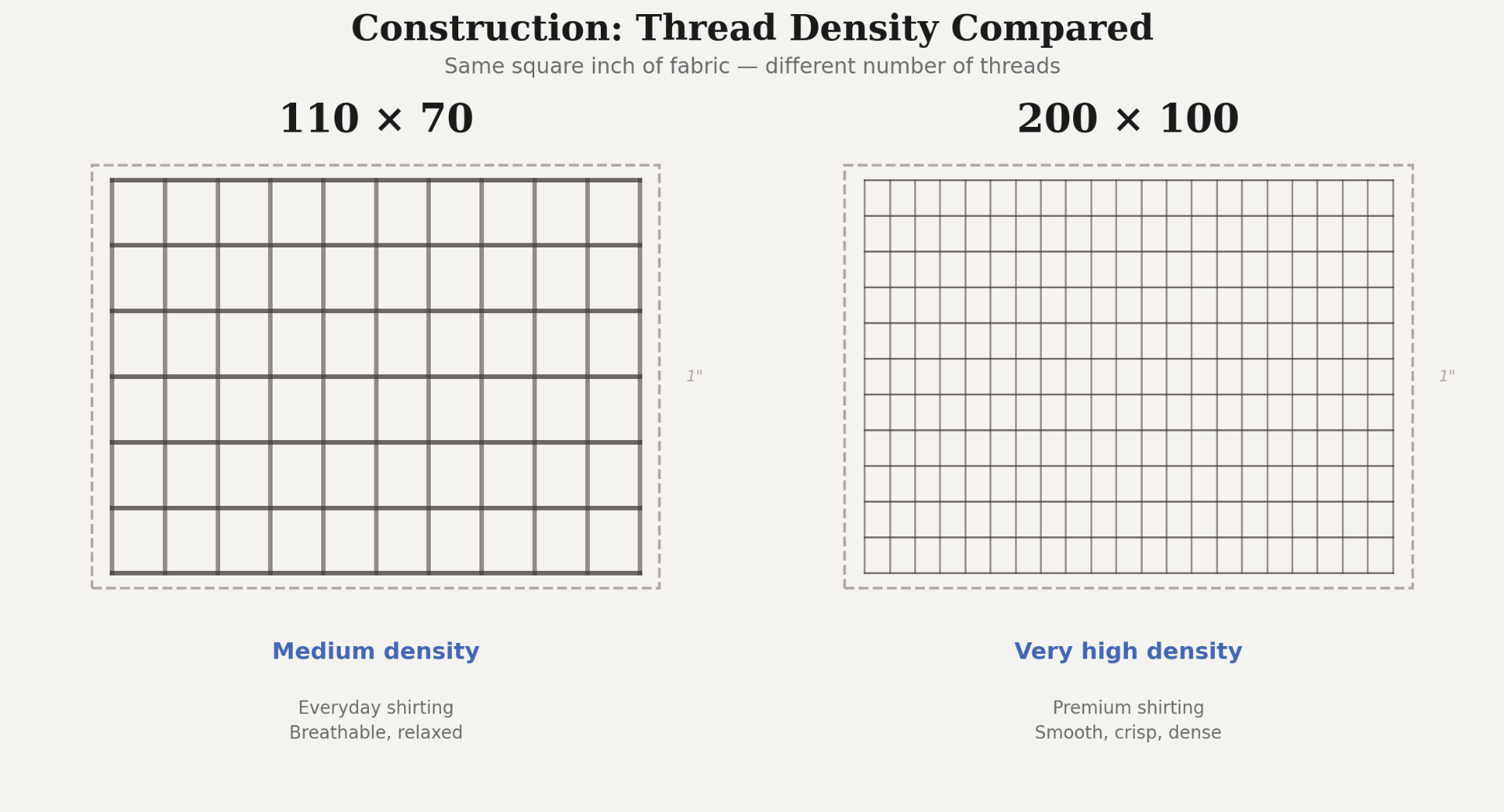
Picture one square inch of fabric — roughly the size of a postage stamp.
200×100 means there are 200 vertical threads and 100 horizontal threads crammed into that tiny square. That's 300 threads total — an extremely tight, dense fabric.
110×70 means 110 vertical and 70 horizontal — only 180 threads total. That's a more open, breathable fabric with more space between the threads.
Why does construction matter?
Higher construction numbers generally mean:
- Tighter weave — less air between yarns
- Better durability — more resistance to tearing and pilling
- Smoother surface — less texture, more refined appearance
- Higher weight — more yarn = more grams per metre
- Less breathability — tighter = less airflow
Lower construction numbers mean:
- Softer, more breathable fabric
- Better drape — the fabric moves more freely
- Slightly less durable — fewer threads holding it together
Common construction ranges for shirting
| Construction | Density | Typical fabric |
|---|---|---|
| 90×60 to 110×70 | ●Low–medium | Casual oxford, relaxed shirts |
| 110×80 to 133×72 | ●Medium | Standard poplin, everyday shirting |
| 133×100 to 160×90 | ●High | Quality dress shirts, refined poplin |
| 200×100 and above | ●Very high | Premium/luxury shirting, extremely smooth |
The relationship between yarn count and construction
Here's the key insight most people miss: finer yarn allows tighter construction.
Think about it this way — if you have thick rope, you can only fit a few pieces side by side in a small space. But if you have thin thread, you can pack hundreds into the same space. It's the same principle with fabric.
You physically can't fit 200 threads per inch using 40s yarn — the threads are too thick. But with 70s or 80s yarn, you can. That's why premium fabrics usually have both a high yarn count AND high construction — the two go hand in hand.
So when you see CPT70×CPT70 / 200×100, it's telling you: fine compact-spun yarn, woven extremely tightly. That combination is what produces a smooth, crisp, high-end shirting fabric.
The Other Specs on the Sheet
Yarn count and construction are the core specs, but you'll see other information too. Here's what the rest means:
Composition
100% COTTON — straightforward. You'll also see blends like 60% Cotton 40% Polyester (CVC) or 70% Cotton 30% Linen. The composition tells you the fibre content, but not how it's spun or woven — that's what yarn count and construction do.
Width
57/58″ is standard shirting fabric width (around 147cm). Some fabrics come at 44/45″ (narrow) or 60/62″ (wide). Width matters for cutting efficiency — wider fabric means less waste per shirt and lower cost per unit.
Finish
LIQUID AMMONIA — this is a premium finishing treatment where the cotton fabric is briefly exposed to liquid ammonia under controlled conditions. This permanently changes the internal structure of the cotton fibres — think of it like straightening out the fibres at a molecular level. The result:
- Noticeably softer hand feel
- Improved wrinkle recovery
- Better dimensional stability (the fabric holds its shape and shrinks less after washing)
- Smoother surface with a slight natural lustre
Other common finishes you'll see:
| Finish | What it does |
|---|---|
| Mercerized | Treated with caustic soda — adds lustre, strength, and dye uptake |
| Non-iron / Easy care | Chemical cross-linking for wrinkle resistance — some hand feel trade-off |
| Peached / Sanded | Mechanically brushed for a softer, slightly fuzzy texture |
| Pre-shrunk / Sanforized | Pre-treated to minimize shrinkage (typically under 2%) |
| LA + Easy Care | Liquid ammonia followed by wrinkle-free treatment — the premium combo |
Weight (GSM)
Some spec sheets include GSM (grams per square metre). This tells you how heavy the fabric is:
- 80–100 GSM: Very light — summer shirting, potentially sheer
- 100–130 GSM: Standard shirting weight
- 130–160 GSM: Medium — oxford cloth, autumn shirts
- 160+ GSM: Heavy — more structured, jacket-weight
GSM is the result of yarn count + construction + weave. Two fabrics can have the same GSM but feel completely different because of how they're woven.
Putting It All Together: Reading a Real Spec
Let's go back to the original example:
FABRIC SPECIFICATION
100% COTTON
CPT70 × CPT70
200 × 100
LIQUID AMMONIA
WIDTH: 57/58″
| Spec | What it's telling you |
|---|---|
| 100% Cotton | Pure cotton, no blends |
| CPT70×CPT70 | The yarn is compact-spun at 70s count — fine, smooth, high-quality thread used in both directions |
| 200×100 | 200 vertical threads and 100 horizontal threads per inch — very tightly woven, dense fabric |
| Liquid Ammonia | Premium finish — makes it softer, smoother, and more wrinkle-resistant |
| Width: 57/58″ | Standard shirting width (about 147cm) |
Bottom line: This is a premium shirting fabric. Fine compact yarn, tightly woven, with a luxury finish. The kind of fabric you'd use for high-end dress shirts or premium retail collections.
Three Mistakes Buyers Make with Specs
Focusing on yarn count but ignoring construction
An 80s yarn woven at 110×70 will feel open and loose. The same 80s yarn at 160×90 will feel crisp and refined. Same yarn, completely different fabric — because the construction is different. You always need both numbers.
Assuming higher is always better
A 120s yarn at extreme density might sound impressive, but the fabric could be too delicate for everyday shirts. The best spec is the one that matches the end product — not the highest number available.
Not checking the finish
Two identical base fabrics with different finishes can feel like completely different products. Liquid ammonia treatment alone can transform a decent fabric into a premium one. Always check what finishing has been applied — it's often the hidden factor that separates good from great.
Want to See the Difference Yourself?
Numbers on a spec sheet tell part of the story. The rest comes from touching the actual fabric — feeling the difference between 40s and 80s, between a standard finish and liquid ammonia, between a loose weave and a tight one.
We can send swatch cards across the range so you can compare side by side. Complimentary swatch cards for qualified trade enquiries.
Need Help Reading a Spec Sheet?
Send us a spec sheet and we'll walk you through it — or request swatch cards to see and feel the fabric yourself. Complimentary swatch cards for qualified trade enquiries; courier charges are normally paid by the buyer.